Century II · Doctor of Unity
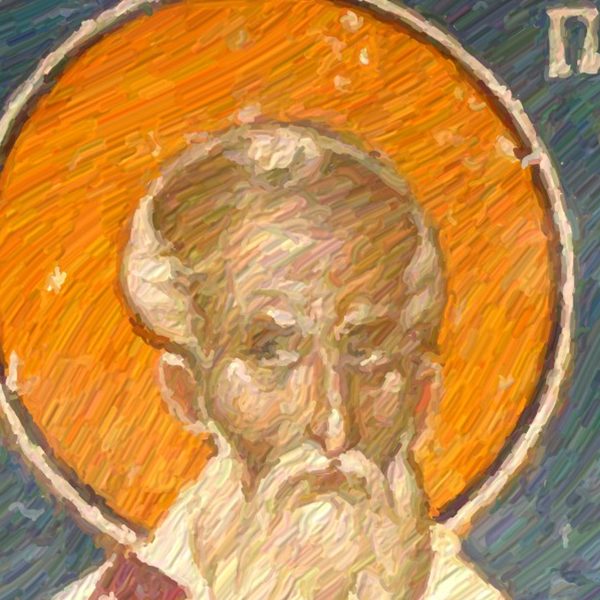
Saint Irenaeus of Lyon
c. 130–c. 202
Born in Smyrna (probably), between 130 and 140 · Died in Lyon (by tradition), c. 202 · Feast: 28 June
He was born in Asia Minor, probably at Smyrna; the Apostolic Letter that declared him a Doctor of the Church places his birth between 130 and 140, and other works of reference put it earlier.
He tells himself that in his early youth he saw Saint Polycarp, bishop of Smyrna, whom the apostles had taught; and in a letter to Florinus that Eusebius preserves he recalls how, while still a boy, he heard Polycarp speak of his converse with John and with the others who had seen the Lord.
When he went to Gaul is not known. In the persecution at Lyon, around 177, he was a presbyter of that church, and the martyrs sent him to Rome with a letter to Pope Eleutherius commending him as zealous for the covenant of Christ; on his return he succeeded Bishop Pothinus, who had died in the persecution at about ninety years of age, in the see of Lyon.
He writes that he lives among the Celts and is busied for the most part with a barbarous tongue, and asks not to be looked to for an art of speech he never learnt.
When Pope Victor would have cut off from communion the churches of Asia, which kept Easter on the fourteenth day of the moon, Irenaeus, writing in the name of the brethren in Gaul over whom he presided, held that it should be kept on the Lord’s day, yet urged Victor not to cut off whole churches that kept the tradition of an ancient custom; Eusebius says that in this he lived up to his name and was a peacemaker.
His great work is the five books of “the exposure and overthrow of the knowledge falsely so called”, as he calls it, known as Against Heresies. He wrote them in Greek, and they survive whole only in an old Latin version, which some of its editors held to have been made in his lifetime or soon after, and other scholars place later, as late as the fourth century. The first book sets out the systems of the Gnostics and the second overthrows them.
Against them he sets the rule of truth received in baptism, the one faith kept alike by the churches in Germany, in Iberia, among the Celts, in the East, in Egypt and in Libya; the tradition of the apostles guarded by the succession of bishops, above all in the church of Rome, founded by Peter and Paul, whose bishops he lists down to Eleutherius, in his day the twelfth from the apostles; the four Gospels, no more and no fewer; the recapitulation of all things in Christ; the knot of Eve’s disobedience, untied by Mary’s obedience; the Eucharist and the resurrection of the flesh.
A second work of his, the Demonstration of the Apostolic Preaching, dedicated to a brother named Marcian and named by Eusebius and Saint Jerome, was thought lost until in 1904 a manuscript of its Armenian version came to light at Yerevan.
When he died is not known. The Apostolic Letter says only that he is reported to have died in 202, and does not call him a martyr; Benedict XVI said that his ministry ended around 202–203, perhaps in martyrdom.
Saint Jerome, who says nothing of his death in his catalogue of the Church’s writers, calls him “bishop of Lyons and martyr” in his commentary on Isaiah, written around 408–410, and Gregory of Tours, at the end of the sixth century, tells that he died a martyr at Lyon. The Church keeps his memorial on 28 June as bishop and martyr.
Pope Francis declared him a Doctor of the Church on 21 January 2022 with the title Doctor unitatis, Doctor of Unity, because, having come from the East, he exercised his ministry as a bishop in the West and became a spiritual and theological bridge between Eastern and Western Christians, and because his name, Irenaeus, expresses the peace that comes from the Lord and reconciles, restoring unity.
Gloria enim Dei vivens homo: vita autem hominis visio Dei.
For the glory of God is a living man, and the life of man is the vision of God.
Translated works
Gloria enim Dei vivens homo: vita autem hominis visio Dei.
For the glory of God is a living man, and the life of man is the vision of God.